Ethics
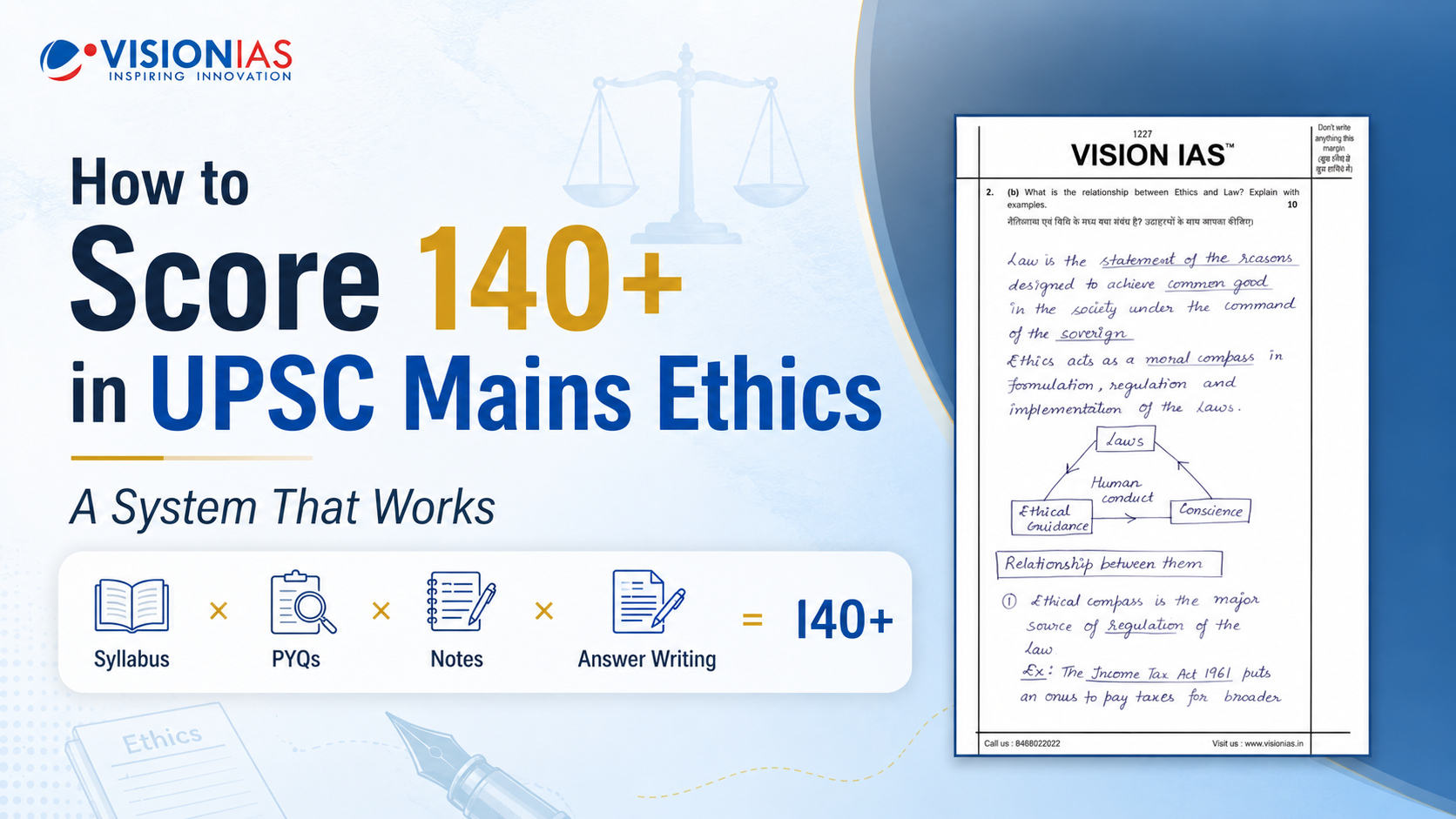
How to Score 140+ in UPSC Mains Ethics (GS Paper 4) — A System That Works










Why Ethics Is a Rank Differentiator
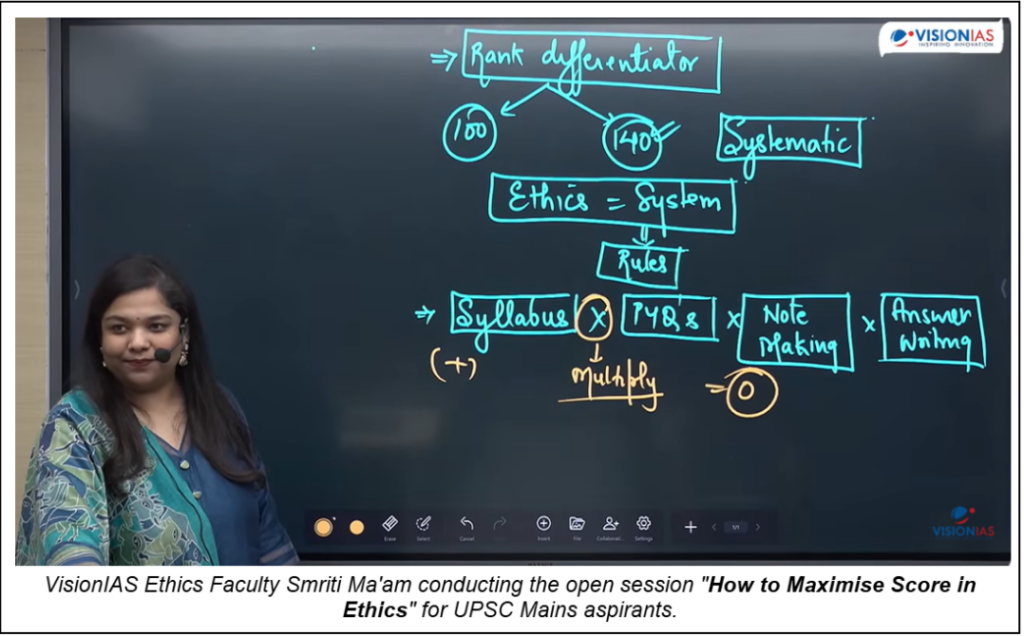
Ethics (GS Paper 4) is arguably the most neglected paper in UPSC mains preparation and that is precisely what makes it a rank differentiator. It is not uncommon to see equally hardworking, equally intelligent students scoring anywhere between 100 and 140+ in ethics. The difference is not intelligence. It is system. Students who score 140+ are more systematic, not smarter.
The four pillars of that system are not additive — they are multiplicative:
| Syllabus × PYQs × Note Making × Answer Writing |
If any one of these is weak or skipped, the entire score suffers. You cannot compensate for skipping answer writing by reading more content. All four must work together.
[Must Watch: How to maximise score in Ethics by Smriti Ma’am]
Pillar 1: Reading the Syllabus the Right Way
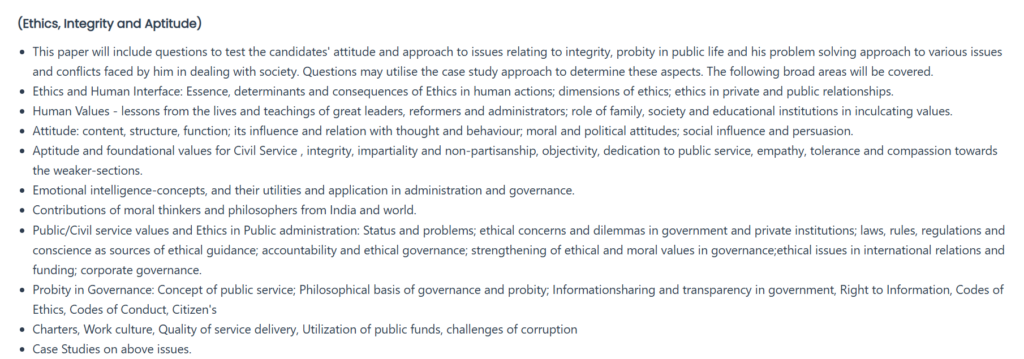
The most common mistake is treating the ethics syllabus as a list of topics to cover. It is not. Every term in the ethics syllabus is a probable 10-marker question. The only variable is how UPSC chooses to frame it.
Integrity, impartiality, compassion, tolerance, emotional intelligence, attitude, social influence, persuasion — every single term has been asked before and can be asked again.
The Six-Dimension Protocol
For each term in the ethics syllabus, prepare notes across six dimensions:
- Definition / Concept — What is the term?
- Features — What are its key characteristics?
- Role in Governance — How does it apply to administration?
- Implications — What happens at individual, societal, national, and global levels?
- Examples — Who has demonstrated (or violated) this value?
- Challenges — What makes it difficult to practice?
Example — Integrity:
- Definition: “Uncompromising adherence to ethical principles” or “reliability in ethical conduct”
- Features: Structural character trait; non-negotiable value; more inward-looking than outward
- Role in governance: Builds credibility → increases public trust → ensures legitimacy; leads to accountability; reduces corruption and abuse of power; enables ethical decision-making
- Implications: Improves interpersonal relations; brings self-satisfaction; creates internal locus of control; reduces cognitive dissonance; makes one a role model
- Examples: T.N. Seshan (election commission), Lal Bahadur Shastri, Ashok Khemka, E. Sridharan
- Challenges: Conformity pressure; “Sanskritization of corruption” (normalising corrupt behaviour for social acceptance); fear of isolation; ethical dilemmas when personal integrity conflicts with professional ethics; emotional fatigue
When every topic is prepared this way, no question can catch you off guard.
Pillar 2: Mining PYQs the Right Way
Simply reading past questions is not PYQ analysis. You need to extract four specific insights from them:
1. Identify High-Frequency Themes
From 2013 to 2025, integrity appeared in 6 section-A questions and over 10 case studies in section-B. Emotional intelligence appeared approximately 8 times. These are high-frequency topics — your note-making for them must be deep and your value additions thorough.
Low-frequency topics (asked only once in 12 years) still need a basic note, but do not demand the same depth.
2. Understand the Paper’s Structure
Section A typically has 13 ten-marker questions. Section B has 6 case studies of 20 marks each (totalling 120 marks). Together, the paper is 250 marks. The pattern can change — UPSC has surprised candidates before — but this has been the consistent format.
3. Note the Directives
The most frequently used directives in ethics from 2013–2025 are:
- Illustrate through examples
- Substantiate through examples
- Justify through examples
This tells you something critical: you will not score in ethics if you are not writing examples. Arguments alone, without examples, will not fetch marks — especially when the question explicitly says “illustrate,” “substantiate,” or “justify.”
| Illustrate = explain with examples (and can include diagrams, flowcharts, data) Substantiate = provide evidence Justify = convince |
In all three, examples are the core. In illustrations, you additionally have the scope to use diagrams and flowcharts.
4. Study the Nature of Questions
PYQs reveal patterns beyond frequency. For instance, questions on “human values” have ranged from conceptual (define, describe features, relative vs. absolute) to value-specific (Is patriotism a value? Is empathy a value?) to agent-based (role of family in shaping values, role of teachers). PYQs also show that UPSC regularly asks about personal experiences — leaders who inspired you, dilemmas from your own life. These cannot be invented on the spot; they need preparation.
Pillar 3: Note Making — Three Stages
Note making happens in three distinct stages. Identify which stage you are currently at and proceed accordingly.
Stage 1: Detailed Notes (Syllabus + PYQ Aligned)
Create comprehensive notes for every topic using the six-dimension protocol. Cross-check against PYQs to ensure you are not missing any sub-themes or question types the examiner has explored before.
Stage 2: Value Addition (The Rank-Making Stage)
This is where the difference between 110 and 140 is built. For every major topic, prepare four banks:
a) Terminology Bank Collect 4–5 specific terms associated with each topic. For integrity:
- “Sanskritization of corruption”
- “Rationalisation culture”
- “Institutionalised integrity” → “probity”
- “Conformity pressure”
- “Emotional fatigue”
These save time, make answers look academic, and can often be used across multiple related topics.
b) Example Bank Prepare examples at multiple levels and in multiple categories:
- Personal example: One genuine personal experience per syllabus term
- Individual / Societal / National / Global level examples
- Historical examples (very useful for negative examples — avoid implicating current authorities)
- Administrative examples (IAS officers, institutions)
- Positive and negative examples (integrity present vs. integrity absent)
Crucially, remember the context, not just the name. Writing “Ashok Khemka” is not enough. The context is: he resisted political pressure in the Vadra-DLF land deal case, demonstrating that an officer with integrity will not compromise even at personal cost. Similarly, E. Sridharan accepted moral responsibility for delays in the Delhi Metro project — a rarity in public life. Context is what earns marks.
Ethics examples double as essay anecdotes — preparing them serves both papers simultaneously.
c) Diagram Bank Diagrams are highly rewarding in ethics and widely underused. Every topic has diagram potential:
- Triangle: For concepts with three components (e.g., Aristotle’s persuasion — ethos, logos, pathos; Kant’s categorical imperative — universality, uniformity, duty)
- Hub and Spoke: For concepts with 5+ components (e.g., Daniel Goleman’s building blocks of emotional intelligence — self-awareness, self-regulation, self-motivation, empathy, social skills)
- Concentric Circles: For nested or layered concepts
- Venn Diagram: For overlapping concepts (e.g., what is legal and ethical / legal but unethical / illegal but ethical / both illegal and unethical)
- Equation: For definitional relationships (e.g., Compassion = Empathy + Action; Courage = Bravery + Awareness of Fear; Integrity = Honesty + Moral Consistency)
- Golden Mean (spectrum): For Aristotelian virtues — cowardice ↔ courage ↔ recklessness; miserly ↔ generous ↔ extravagant
- Vicious/Virtuous Cycle: For cause-effect chains in governance or social issues
Always box diagrams, give them a heading, and ensure the surrounding text provides the context in which the diagram was made.
d) Quote Bank Quotes elevate answer quality — but only when used naturally, not forced. The best source is PYQs themselves: three quote-based questions appear almost every year, so preparing the quotes from past papers means you are also learning the themes.
Useful quotes for integrity:
- “Integrity is doing the right thing when no one is watching.” — C.S. Lewis
- “If you have integrity, nothing else matters. And if you do not have integrity, nothing else matters.” — Alan K. Simpson
- “There is no right time to do the right thing.” — Martin Luther King Jr.
If you cannot remember a name or exact wording on exam day, use single inverted commas without attribution. Never write a wrong name, and never write “anonymous” — it signals unpreparedness.
Stage 3: One-Pager Revision Notes
Before the exam, condense each topic to one A4 page. Do not write full sentences — only keywords, diagrams, and pointers. A 50-topic syllabus = 50 pages = 25 A4 sheets (front and back). This is entirely revisable in the days before the exam.
Download VisionIAS Ethics Value Added Material (VAM)

Pillar 4: Answer Writing
Introduction (Six Ways to Begin)
Avoid writing the same type of introduction for every answer. Rotate among:
- Define the keyword in the question (most common, but monotonous if overused)
- Give the premise — a contemporary context that makes the question relevant (e.g., debates around marital rape, same-sex marriage, transgender rights as examples of ethics shaping law)
- Highlight the significance of the key term in administration
- Start with a quote related to the theme
- Give the interpretation (especially for quote-based questions)
- Open with a recent example, data, report, or index
When using a definition, attach an example alongside it — the combination conveys your intent to the examiner far more clearly than a definition alone.
For quote-based questions: do not start with the quote itself. It creates confusion about which quote is being answered. Paraphrase it, or open with a contemporary event that the quote illuminates.
Hindi can be used in Roman script, but must be immediately followed by an English explanation in the same line.
Body: The KEE Format
Every paragraph in the body follows:
| Keyword → Explanation → Example |
You can either explain through the example (letting the example do the explanatory work) or explain first and follow with the example. Either is acceptable. What is not acceptable is an argument without an example.
Write at least 4–5 distinct arguments in a 10-marker question. Two or three arguments elaborated at length will not earn full marks. Breadth matters.
Wherever possible, incorporate:
- Diagrams (boxed, with headings)
- Flowcharts and vicious/virtuous cycles
- Tabular comparisons (when the question asks you to differentiate)
- A counter-argument (if the question calls for a nuanced stand)
Underline important terms — but check the spelling of underlined words carefully. Identify and highlight keywords at the start of each paragraph so the examiner can see the argument’s thread at a glance.
For multi-part questions: mentally allocate marks to each sub-part before you begin writing. A question with three parts does not necessarily get equal space — allocate based on the depth the directive demands.
Conclusion: Two Levels
Penultimate conclusion (Prescription / Way Forward): What should be done? How can the relevant virtue or principle be developed or strengthened? This can draw on socialization (family, education, media), emotional intelligence frameworks, or normative ethics (virtue ethics, deontological ethics, care ethics, justice-based ethics).
Ultimate conclusion (Overall Inference): Your final stand after the argument. This is where you have the most creative scope: a relevant couplet (doha), a shloka, a tagline, an SDG linkage, or a one-line synthesis of your argument.
For quote-based questions, prescription is mandatory in the conclusion — the quote has offered wisdom; your job is to prescribe how that wisdom can be instilled in society.
Do not label your conclusion with the heading “Conclusion” — just write it. Do not end on the prescription alone if space permits; add one final inference line.
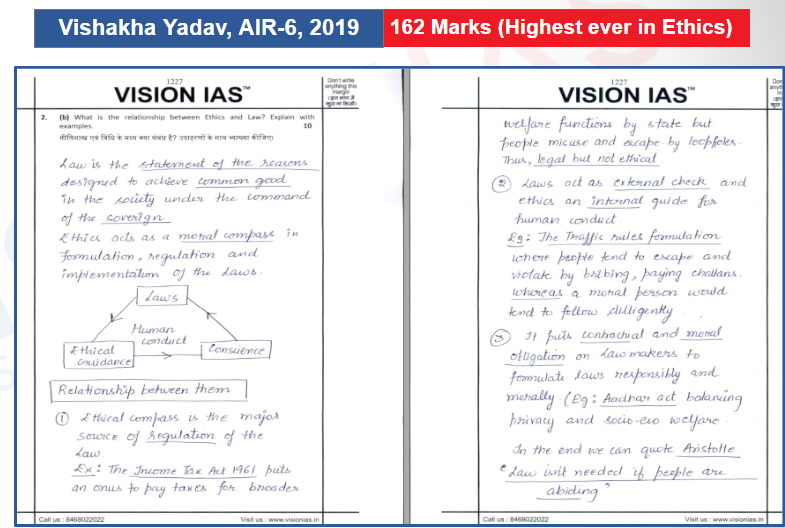
[Download Latest and Previous Year High Scorer Ethics Topper Copies]
On Using AI Effectively
AI is a useful tool — but only for the right tasks:
- To generate diagram ideas for a specific concept
- To find synonyms or better vocabulary for a term
- To look up an example or quote you cannot recall
Never use AI to answer a question for you. Your interpretation of the question must always come first. You can cross-verify or improve with AI after your first attempt — but the thinking must be your own.
Exam-Day Pointers
- Always complete the paper. An unanswered sub-part earns zero, no matter how well the rest was written.
- Do not bluff data, names, or statistics. A single incorrect fact in an otherwise excellent paper can create a lasting negative impression.
- Source any data or reports you cite (Census, NFHS, Periodic Labour Force Survey, etc.).
- For those with humanities optionals (Sociology, PSIR, Philosophy, etc.): ethics and essay are the only GS papers where theoretical insights from your optional can be woven in naturally. Use them where relevant, never forcefully.
- Target: at least 125 in ethics to maintain a competitive total. Both sections (theory and case studies) must be equally strong.
Strategy Based on Where You Are
- Just starting out / No notes yet: Build detailed notes using the Syllabus + PYQ approach with the six-dimension protocol. December is a realistic target to complete this stage for next year’s aspirants.
- Notes exist but need refinement: Align them with PYQs, then move directly to value addition (terminology bank, example bank, diagram bank, quote bank).
- Notes complete and PYQ-aligned: Focus entirely on value addition and start building one-pagers. Begin answer writing immediately.
- Writing mains this year: Prioritise one-pagers and value addition over starting from scratch. Every night, spend one hour on the value-addition copy — reviewing or adding to it. Consistent daily effort compounds rapidly.
“There is no right time to do what is right.”
The best preparation is not the one with the most material. It is the one that is systematic, practiced, and ready. Start where you are, use what you have, and write — because good marks in ethics always begin on the page.